

A Really Simple Syllabus Process for Instructors
As you begin your transition to Simple Syllabus, here is a high level view of the top 5 steps to get you started.

1. Accessing Simple Syllabus in Canvas
The Course Syllabus link is how you and your students will access Simple Syllabus while working in Canvas. Alternatively, you may access and edit your syllabus within the Simple Syllabus website by logging in at syllabus.fscj.edu, but we recommend editing in Canvas since most instructors are already used to working in Canvas anyway.
Canvas has a default syllabus link called Syllabus. This link does NOT connect to Simple Syllabus (use Course Syllabus for that). Most instructors probably do not need both a Course Syllabus and Syllabus link. If you do not use the Canvas default Syllabus page, we recommend that you disable it to prevent possible confusion. To do so:
Log in to Canvas by visiting canvas.fscj.edu and open the course you would like to enable Simple Syllabus in.
In Course Navigation, click the Settings link.
Click the Navigation tab.
Drag Syllabus it to the bottom of the list which will hide it in the course navigation. Alternatively, you can click the three dots to the right and select Disable.
Scroll down and click Save to confirm your change.
2. Review the Note to Faculty
When you begin to edit your syllabus, you’ll first be presented with a blue box of text that has each critical item you’ll need to know for syllabus creation. Here, you’ll learn which components are required and which are optional, how to add and reorder components, and how to submit your completed syllabus.
3. Editing the Syllabus: A Note on Special Components
Many components are pre-populated with data directly from PeoplesSoft. Others, need your personalized touch. Some of these components are self explanatory; however, we’ve included help text to the right of each component in case you get stuck. There are a few components however, that we’d like to call your attention to in advance.
Course Outline
The Course Outline is required, and there are many ways this component can be completed. Florida requires that each syllabus has a list of “assignments, including at a minimum, the assignment title, a brief narrative description of the assignment, and, if applicable, any required readings.” Much of this information can be included in the Course Outline area. Many instructors provide a weekly or module schedule of topics, assignments, readings, and grades. Please reach out to your supervisor for additional guidance on your area’s preference for listing these requirements.
Please note: having a sentence that says “see Canvas for full course outline” does NOT meet the state’s requirement of having this information displayed in the syllabus.
Course Calendar
If you use Canvas discussions, assignments, or quizzes, this component will sync with Canvas to show each of these along with their due date and points. Please keep in mind that the Course Calendar in the syllabus only shows published assignments. . Ideally, you will want to create your Canvas assignments before submitting your syllabus. However, if you added or edit your assignments in Canvas after submitting your syllabus, you can go into this component and re-sync then submit again to ensure the component remains current.
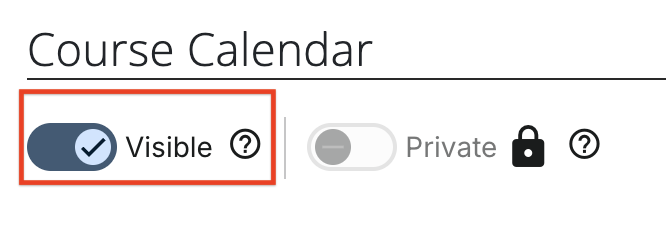
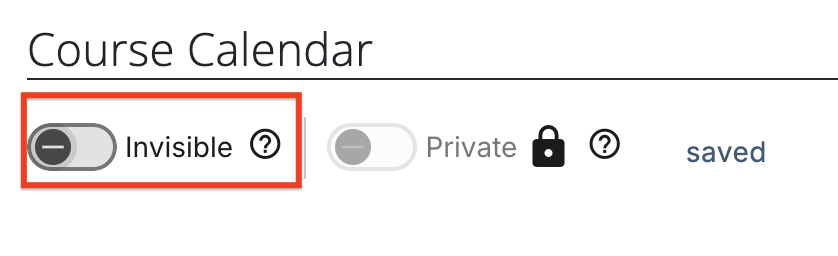
Note that this component is optional. If you do not with to use this component, then you can toggle the visibility to invisible, which will prevent this component from showing in the published syllabus. The word “Visible” with a check mark indicates the component will be visible on the published syllabus. Toggle to “Invisible” with a greyed out button to hide the component from the published syllabus.
4. Complete the Required Components
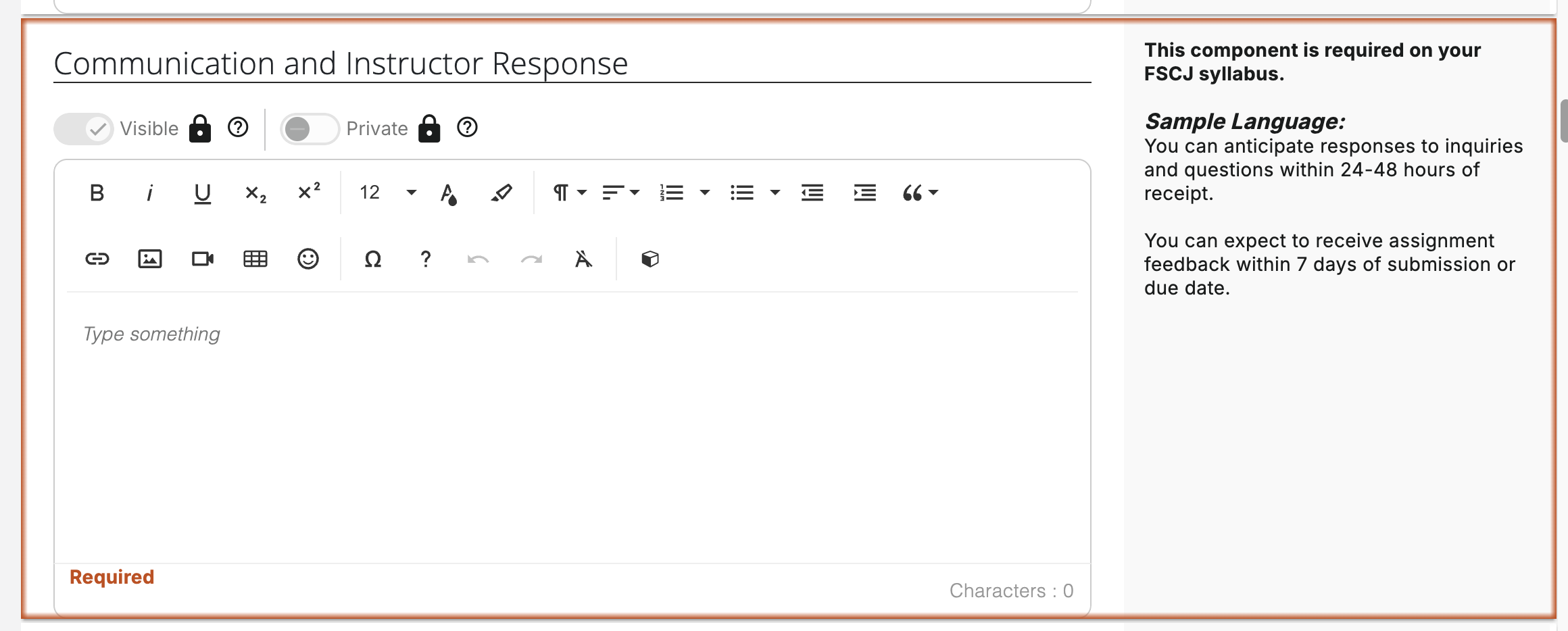
Required components are indicated with an orange box around the component and the word “required” in the lower left. The help text will also indicate if a component is required or optional.
Although many of the required components are pre-populated, there are others that you will need to add content into. For many components, we have included sample language for your convenience. Feel free to use this, add and adjust it, or use your own that you have prepared. To complete your syllabus, there are components that are required and content must be added to prior to submitting. Other editable, required components should be reviewed prior to submission. You may notice that your content will save automatically as you edit the syllabus, so feel free to navigate away and come back later without any worry.
5. Submit and Share Your Syllabus

Once you complete all components and have the best, personalized syllabus that prepares students for the course ahead of them, you’ll simply submit your syllabus. To do so, click the Submit button. Once submitted, the syllabus is automatically available on the FSCJ Public Syllabus Library, where you or your students can View, Share, or Print it.
To find your syllabus within the public syllabus library site, visit fscj.simplesyllabus.com. Use the term, course prefix or number, or instructor filter to search for your syllabus. When you locate your syllabus, it’s easy to view, print, or share - only available when logged in.
Select the View button to see the online version of your syllabus. You may copy the link and share that directly with students.
The Print button will open a PDF version of your syllabus. This can be shared or sent to a printer if a paper version of your syllabus is preferred.
Using your College credentials, you can login to Simple Syllabus in the upper right corner of the site. If logged in, the Share button will be available to you on your syllabi.
Share gives you the option to copy the link, PDF or embed the syllabus.
For comprehensive syllabus training, please review options available via myLEARNING.
